The BibleGospel Companion

Mordecai

מׇרְדֳּכַי · mor.de.khay · H4782H“contrition; bitter; bruising” Hitchcock's 186950 mentions, all in Esther
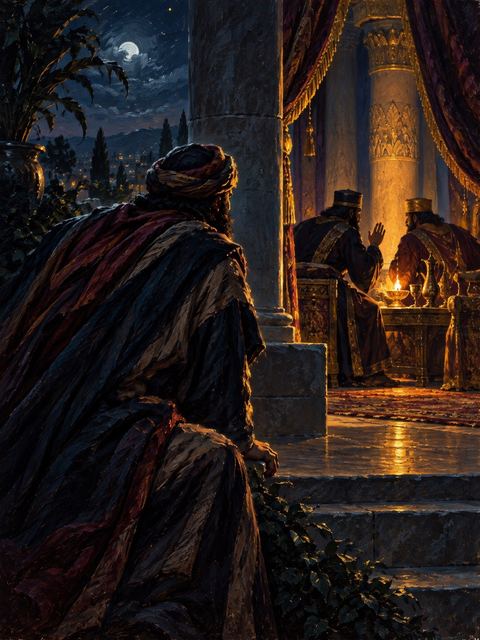
Illustration — not a likeness; generated for Gospel Companion in the app's painting style — Mordecai
Illustration — not a likeness; generated for Gospel Companion in the app's painting style

Who he was

Mordecai, a prominent figure in the book of Esther, was a Jewish man living in the Persian capital of Susa during the reign of King Ahasuerus (Xerxes I). He was the son of Jair, from the tribe of Benjamin, and had been taken into exile from Jerusalem by Nebuchadnezzar, the king of Babylon (Esther 2:5–6).

Mordecai is best known for his role as the cousin and guardian of Esther, who became queen of Persia. When Esther's parents died, Mordecai took her as his own daughter and raised her (Esther 2:7). He later advised her to keep her Jewish identity secret when she was taken into the king's harem (Esther 2:10).

Mordecai's loyalty to the king was demonstrated when he uncovered a plot by two of the king's eunuchs to assassinate Ahasuerus. He reported the conspiracy, and the eunuchs were hanged (Esther 2:21–23).

However, Mordecai's refusal to bow down to Haman, a high-ranking official in the Persian court, led to a crisis for the Jewish people. Haman, enraged by Mordecai's defiance, plotted to destroy all the Jews in the empire (Esther 3:5–6). Mordecai then urged Esther to intervene on behalf of her people, even at the risk of her own life (Esther 4:13–14).

Through Esther's courage and Mordecai's guidance, Haman's plot was exposed, and the king issued a decree allowing the Jews to defend themselves. Haman was hanged on the gallows he had prepared for Mordecai (Esther 7:9–10).

After this victory, Mordecai was elevated to a high position in the Persian court, second only to the king (Esther 10:3). He used his influence to promote the welfare of the Jewish people and institute the festival of Purim to commemorate their deliverance (Esther 9:20–32).

Throughout the book of Esther, Mordecai is portrayed as a wise, courageous, and faithful leader who risked his own life to protect his people and remained committed to his Jewish identity in the face of adversity.

Article: STEPBible, Tyndale House Cambridge · CC BY 4.0

Family

FatherJair
Family relations: STEPBible, Tyndale House Cambridge · CC BY 4.0

Every mention

50 references, counted from STEPBible, Tyndale House Cambridge · CC BY 4.0 · verse text: World English Bible (public domain)

Esther 50 mentions

Esther 2:5There was a certain Jew in the citadel of Susa whose name was Mordecai, the son of Jair, the son of Shimei, the son of Kish, a Benjamite,Esther 2:7He brought up Hadassah, that is, Esther, his uncle’s daughter; for she had neither father nor mother. The maiden was fair and beautiful; and when her father and mother were dead, Mordecai…Esther 2:10Esther had not made known her people nor her relatives, because Mordecai had instructed her that she should not make it known.Esther 2:11Mordecai walked every day in front of the court of the women’s house, to find out how Esther was doing, and what would become of her.Esther 2:15Now when the turn of Esther, the daughter of Abihail the uncle of Mordecai, who had taken her for his daughter, came to go in to the king, she required nothing but what Hegai the king’s…Esther 2:19When the virgins were gathered together the second time, Mordecai was sitting in the king’s gate.Esther 2:20Esther had not yet made known her relatives nor her people, as Mordecai had commanded her; for Esther obeyed Mordecai, like she did when she was brought up by him.Esther 2:21In those days, while Mordecai was sitting in the king’s gate, two of the king’s eunuchs, Bigthan and Teresh, who were doorkeepers, were angry, and sought to lay hands on the King Ahasuerus.Esther 2:22This thing became known to Mordecai, who informed Esther the queen; and Esther informed the king in Mordecai’s name.Esther 3:2All the king’s servants who were in the king’s gate bowed down and paid homage to Haman, for the king had so commanded concerning him. But Mordecai didn’t bow down or pay him homage.Esther 3:3Then the king’s servants who were in the king’s gate said to Mordecai, “Why do you disobey the king’s commandment?”Esther 3:4Now it came to pass, when they spoke daily to him, and he didn’t listen to them, that they told Haman, to see whether Mordecai’s reason would stand; for he had told them that he was a Jew.Esther 3:5When Haman saw that Mordecai didn’t bow down nor pay him homage, Haman was full of wrath.Esther 3:6But he scorned the thought of laying hands on Mordecai alone, for they had made known to him Mordecai’s people. Therefore Haman sought to destroy all the Jews who were throughout the whole…Esther 4:1Now when Mordecai found out all that was done, Mordecai tore his clothes and put on sackcloth with ashes, and went out into the middle of the city, and wailed loudly and bitterly.Esther 4:4Esther’s maidens and her eunuchs came and told her this, and the queen was exceedingly grieved. She sent clothing to Mordecai, to replace his sackcloth, but he didn’t receive it.Esther 4:5Then Esther called for Hathach, one of the king’s eunuchs, whom he had appointed to attend her, and commanded him to go to Mordecai, to find out what this was, and why it was.Esther 4:6So Hathach went out to Mordecai, to the city square which was before the king’s gate.Esther 4:7Mordecai told him of all that had happened to him, and the exact sum of the money that Haman had promised to pay to the king’s treasuries for the destruction of the Jews.Esther 4:9Hathach came and told Esther the words of Mordecai.Esther 4:10Then Esther spoke to Hathach, and gave him a message to Mordecai:Esther 4:12They told Esther’s words to Mordecai.Esther 4:13Then Mordecai asked them to return this answer to Esther: “Don’t think to yourself that you will escape in the king’s house any more than all the Jews.Esther 4:15Then Esther asked them to answer Mordecai,Esther 4:17So Mordecai went his way, and did according to all that Esther had commanded him.Esther 5:9Then Haman went out that day joyful and glad of heart, but when Haman saw Mordecai in the king’s gate, that he didn’t stand up nor move for him, he was filled with wrath against Mordecai.Esther 5:13Yet all this avails me nothing, so long as I see Mordecai the Jew sitting at the king’s gate.”Esther 5:14Then Zeresh his wife and all his friends said to him, “Let a gallows be made fifty cubits high, and in the morning speak to the king about hanging Mordecai on it. Then go in merrily with…Esther 6:2It was found written that Mordecai had told of Bigthana and Teresh, two of the king’s eunuchs, who were doorkeepers, who had tried to lay hands on the King Ahasuerus.Esther 6:3The king said, “What honor and dignity has been given to Mordecai for this?” Then the king’s servants who attended him said, “Nothing has been done for him.”Esther 6:4The king said, “Who is in the court?” Now Haman had come into the outer court of the king’s house, to speak to the king about hanging Mordecai on the gallows that he had prepared for him.Esther 6:10Then the king said to Haman, “Hurry and take the clothing and the horse, as you have said, and do this for Mordecai the Jew, who sits at the king’s gate. Let nothing fail of all that you…Esther 6:11Then Haman took the clothing and the horse, and arrayed Mordecai, and had him ride through the city square, and proclaimed before him, “Thus it shall be done to the man whom the king…Esther 6:12Mordecai came back to the king’s gate, but Haman hurried to his house, mourning and having his head covered.Esther 6:13Haman recounted to Zeresh his wife and all his friends everything that had happened to him. Then his wise men and Zeresh his wife said to him, “If Mordecai, before whom you have begun to…Esther 7:9Then Harbonah, one of the eunuchs who were with the king, said, “Behold, the gallows fifty cubits high, which Haman has made for Mordecai, who spoke good for the king, is standing at…Esther 7:10So they hanged Haman on the gallows that he had prepared for Mordecai. Then the king’s wrath was pacified.Esther 8:1On that day, King Ahasuerus gave the house of Haman, the Jews’ enemy, to Esther the queen. Mordecai came before the king; for Esther had told what he was to her.Esther 8:2The king took off his ring, which he had taken from Haman, and gave it to Mordecai. Esther set Mordecai over the house of Haman.Esther 8:7Then King Ahasuerus said to Esther the queen and to Mordecai the Jew, “See, I have given Esther the house of Haman, and they have hanged him on the gallows because he laid his hand on the…Esther 8:9Then the king’s scribes were called at that time, in the third month, which is the month Sivan, on the twenty-third day of the month; and it was written according to all that Mordecai…Esther 8:15Mordecai went out of the presence of the king in royal clothing of blue and white, and with a great crown of gold, and with a robe of fine linen and purple; and the city of Susa shouted…Esther 9:3All the princes of the provinces, the local governors, the governors, and those who did the king’s business helped the Jews, because the fear of Mordecai had fallen on them.Esther 9:4For Mordecai was great in the king’s house, and his fame went out throughout all the provinces, for the man Mordecai grew greater and greater.Esther 9:20Mordecai wrote these things, and sent letters to all the Jews who were in all the provinces of the King Ahasuerus, both near and far,Esther 9:23The Jews accepted the custom that they had begun, as Mordecai had written to them,Esther 9:29Then Esther the queen, the daughter of Abihail, and Mordecai the Jew wrote with all authority to confirm this second letter of Purim.Esther 9:31to confirm these days of Purim in their appointed times, as Mordecai the Jew and Esther the queen had decreed, and as they had imposed upon themselves and their descendants in the matter…Esther 10:2Aren’t all the acts of his power and of his might, and the full account of the greatness of Mordecai, to which the king advanced him, written in the book of the chronicles of the kings of…Esther 10:3For Mordecai the Jew was next to King Ahasuerus, and great among the Jews and accepted by the multitude of his brothers, seeking the good of his people and speaking peace to all his…

What the dictionary says

The son of Jair, of the tribe of Benjamin.

Easton's Bible Dictionary (1897)
Read the article →

Sources