Counted from 11 references · STEPBible, Tyndale House Cambridge · CC BY 4.0
About this place
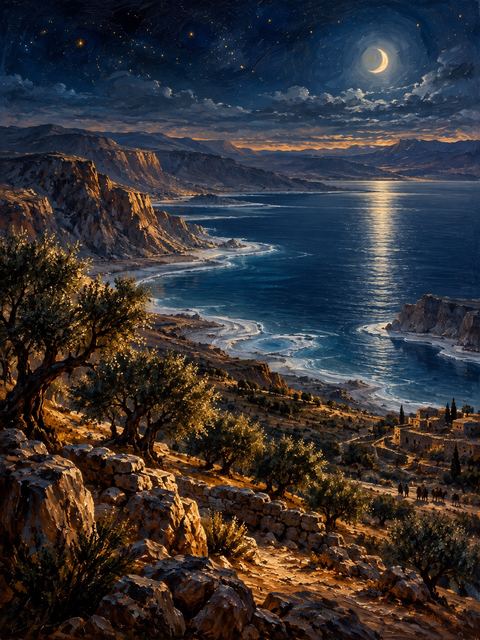
The Salt Sea, also referred to as the Sea of Arabah, is the biblical name for what is now known as the Dead Sea. It is a large, landlocked salt lake located in the Jordan Rift Valley, bordered by Israel and the West Bank to the west and Jordan to the east. The Salt Sea is fed by the Jordan River and is known for its high salt content, which makes it inhospitable to marine life. In the Bible, the Salt Sea is often used as a geographical marker, particularly in relation to the boundaries of the Promised Land (Num. 34:3, 12; Josh. 15:2, 5; 18:19). It is also mentioned in the context of historical events, such as the battle between the kings of the region and the kings of Sodom and Gomorrah (Gen. 14:3) and the extent of Jeroboam II's territorial expansion (2Ki. 14:25). The Salt Sea's unique characteristics, including its low elevation and high salinity, have made it a significant feature in the biblical landscape.
Article: STEPBible, Tyndale House Cambridge · CC BY 4.0
Every mention
11 references, counted from STEPBible, Tyndale House Cambridge · CC BY 4.0 · verse text: World English Bible (public domain)