Ashdod
Where it is
31.80° N, 34.64° E
Mentioned most in
About this place
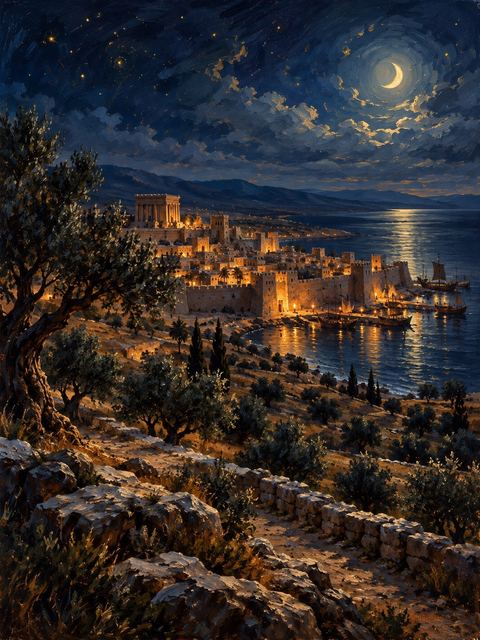
Ashdod was one of the five major cities of the Philistine pentapolis. Located in the tribal territory allocated to Judah, it remained predominantly under Philistine control throughout much of its history.
The city first appears in biblical records as one of the few places where the Anakim (giants) survived after Joshua's conquest. Though assigned to Judah, it remained a Philistine stronghold. The city gained particular prominence during the episode of the captured Ark of the Covenant. After defeating the Israelites, the Philistines brought the Ark to Ashdod and placed it in the temple of their god Dagon. This resulted in the statue of Dagon falling and breaking, followed by an outbreak of tumors among the city's inhabitants, leading them to send the Ark away.
King Uzziah of Judah later broke down the walls of Ashdod and built cities in its territory. The city faced multiple military campaigns, including an Assyrian conquest mentioned by Isaiah. The prophet Amos used Ashdod as a reference point for neighboring nations to witness Egypt's moral corruption.
Several prophets pronounced judgment against Ashdod. Jeremiah included it among the cities to drink the cup of God's wrath. Amos, Zephaniah, and Zechariah all prophesied its downfall or conquest.
In the post-exilic period, Nehemiah noted that some Jews had married women from Ashdod, resulting in their children speaking the language of Ashdod rather than Hebrew. This was viewed as a serious problem during the restoration of Jerusalem.
The city continued to exist into New Testament times, where it is referred to by its Greek name Azotus. It appears in Acts as one of the places where Philip the evangelist preached after his encounter with the Ethiopian eunuch.
Probably corresponds to modern Esdud in Israel, located between ancient Joppa and Gaza.
Every mention
Joshua4 mentions
1 Samuel6 mentions
Nehemiah3 mentions
Isaiah1 mention
Amos2 mentions
Zephaniah1 mention
Zechariah1 mention
What the dictionary says
Stronghold, a Philistine city (Josh. 15:47), about midway between Gaza and Joppa, and 3 miles from the Mediterranean.
Sources
- STEPBible TIPNR · Translators Individualised Proper Names with all References · CC BY 4.0 · github.com/STEPBible/STEPBible-Data
- OpenBible.info Bible Geocoding · CC BY 4.0 · www.openbible.info/geo/
- Hitchcock's Bible Names Dictionary (1869) · Public domain