Naboth
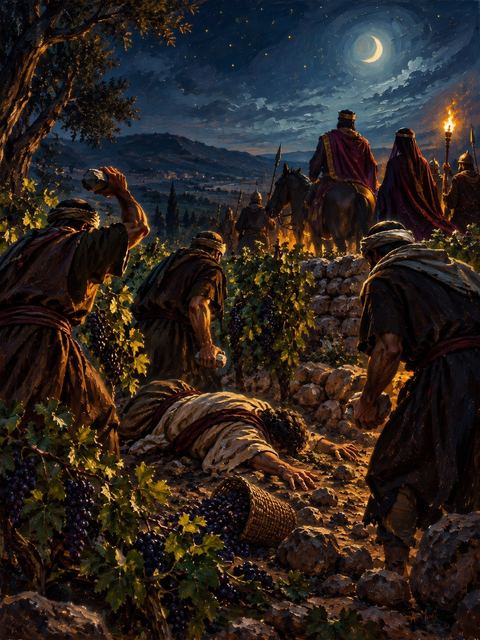
Who he was
Naboth was a Jezreelite who owned a vineyard adjacent to the palace of King Ahab of Israel. His story, recorded in 1Kings 21 and 2Kings 9, is a tragic account of injustice and the abuse of power.
King Ahab desired to acquire Naboth's vineyard to use as a vegetable garden, offering to purchase it or provide a better vineyard in exchange. However, Naboth refused, stating that he could not give up the inheritance of his ancestors (1 Kings 21:1–3). This refusal greatly displeased Ahab, who sulked and refused to eat.
Ahab's wife, Queen Jezebel, learning of the situation, devised a wicked plan to secure the vineyard. She wrote letters in Ahab's name, ordering the elders and nobles of Jezreel to proclaim a fast and seat Naboth in a prominent place. Then, they were to have two scoundrels accuse Naboth of cursing God and the king, leading to his execution by stoning (1 Kings 21:8–14).
The plan was carried out, and Naboth was unjustly killed. After his death, Ahab took possession of the vineyard (1 Kings 21:15–16). However, the prophet Elijah confronted Ahab, pronouncing God's judgment on him and his household for their wickedness (1 Kings 21:17–24).
Years later, as prophesied by Elijah, Ahab's son King Joram was killed by Jehu in the same plot of land that had belonged to Naboth (2 Kings 9:21–26), fulfilling the divine retribution for the unjust murder of Naboth and the seizure of his ancestral property.
Naboth's story illustrates the importance of justice, the sanctity of ancestral inheritance, and the consequences of abusing power and disregarding God's laws. It also demonstrates the role of prophets in speaking truth to power and pronouncing judgment on those who commit evil.
Every mention
1 Kings15 mentions
2 Kings3 mentions
What the dictionary says
Fruits, “the Jezreelite,” was the owner of a portion of ground on the eastern slope of the hill of Jezreel (2 Kings 9:25, 26).
Sources
- STEPBible TIPNR · Translators Individualised Proper Names with all References · CC BY 4.0 · github.com/STEPBible/STEPBible-Data
- Hitchcock's Bible Names Dictionary (1869) · Public domain