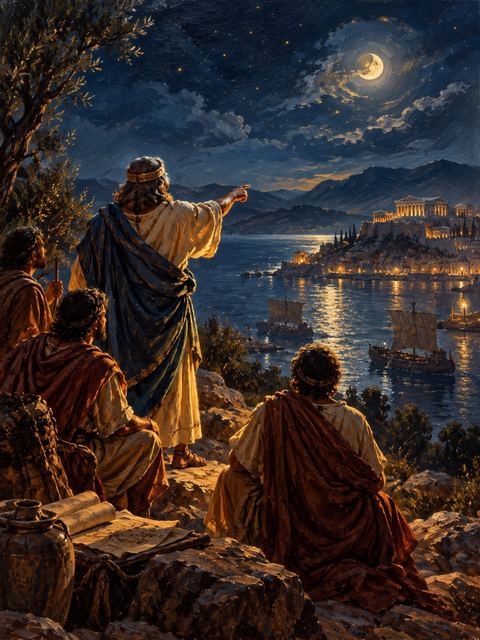
Illustration — not a likeness; generated for Gospel Companion in the app's painting style
Who he was
Javan is mentioned in the Table of Nations (Gen.10.2,4; 1Ch.1.5,7) as one of the sons of Japheth and grandsons of Noah. He is considered the ancestor of the Greek people, and his name is often used in the Bible as a reference to Greece or the Greek people. In the Old Testament, Javan is associated with the trading of slaves (Joel 3:6), suggesting that the Greeks were involved in the slave trade. In the New Testament, the term "Greeks" (Hellenes) is used to refer to non-Jewish people, particularly those influenced by Greek culture. The Greeks are mentioned in various contexts, such as seeking Jesus (John 12:20), attending synagogues (Act.14.1; 17.4; 18.4), and being among the first Gentile converts to Christianity (Act.16.1,3). The inclusion of Greeks in the early church underscores the universal nature of the gospel message (Rom.1.16; 10.12; Galatians 3:28). The Greeks are also depicted as seekers of wisdom (1 Corinthians 1:22) and are contrasted with the Jews in terms of their religious and cultural background (Rom.1.14; 2.9-10; 1Co.10.32; 12.13). In Mark 7:26, a Syrophoenician woman is described as a Greek, highlighting the widespread influence of Greek culture in the region.
Article: STEPBible, Tyndale House Cambridge · CC BY 4.0
(1.) The fourth “son” of Japheth (Gen. 10:2), whose descendants settled in Greece, i.e., Ionia, which bears the name of Javan in Hebrew. Alexander the Great…