Beersheba
Where it is
31.24° N, 34.84° E
Mentioned most in
About this place
Beersheba, also known as Sheba or Shibah, was a significant city located in the Negev region of southern Israel. It is mentioned numerous times throughout the Old Testament and is closely associated with the patriarchs Abraham, Isaac, and Israel (or 'Jacob').
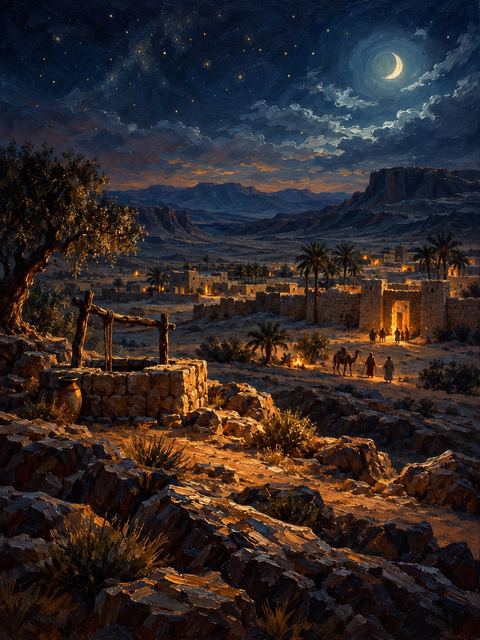
The name "Beersheba" first appears in Genesis 21:31, where Abraham named the place after making a covenant with Abimelech, the king of Gerar. The name means "well of seven" or "well of the oath," referring to the seven ewe lambs that Abraham gave to Abimelech as a witness to the covenant (Genesis 21:28-31).
Abraham lived in Beersheba for a time (Genesis 22:19), and it was from there that he set out to offer his son Isaac as a sacrifice in the land of Moriah (Genesis 22:1-19). Isaac also lived in Beersheba, where he built an altar and called upon the name of the Lord (Genesis 26:23-25, 33). Jacob left Beersheba to go to Haran (Genesis 28:10) and later returned there to offer sacrifices to God before going to Egypt (Genesis 46:1, 5).
In the later history of Israel, Beersheba marked the southern extent of the nation, as seen in the phrase "from Dan to Beersheba" (Judges 20:1; 1Sa.3.20; 2Sa.3.10; 17:11; 24:2, 15; 1Ki.4.25). The city was allotted to the tribe of Simeon (Joshua 19:2) and became part of the kingdom of Judah (2Sa.24.7).
Beersheba was also a center of idolatry, as evidenced by the references to the "way of Beersheba" (Amo.8.14) and the "sin of Samaria" (Amo.5.5). King Josiah removed the idolatrous priests and destroyed the high places from Geba to Beersheba as part of his religious reforms (2Ki.23.8).
In summary, Beersheba was a prominent city in the Negev, serving as a key location in the lives of the patriarchs and later as a boundary marker for the nation of Israel. Its history was marked by both faithfulness to God and idolatry.
Every mention
Genesis10 mentions
Joshua2 mentions
1 Samuel2 mentions
2 Samuel5 mentions
1 Kings2 mentions
2 Kings2 mentions
1 Chronicles2 mentions
2 Chronicles3 mentions
Nehemiah2 mentions
Amos2 mentions
What the dictionary says
Well of the oath, or well of seven, a well dug by Abraham, and so named because he and Abimelech here entered into a compact (Gen. 21:31).
Sources
- STEPBible TIPNR · Translators Individualised Proper Names with all References · CC BY 4.0 · github.com/STEPBible/STEPBible-Data
- OpenBible.info Bible Geocoding · CC BY 4.0 · www.openbible.info/geo/
- Hitchcock's Bible Names Dictionary (1869) · Public domain