Solomon
Who he was
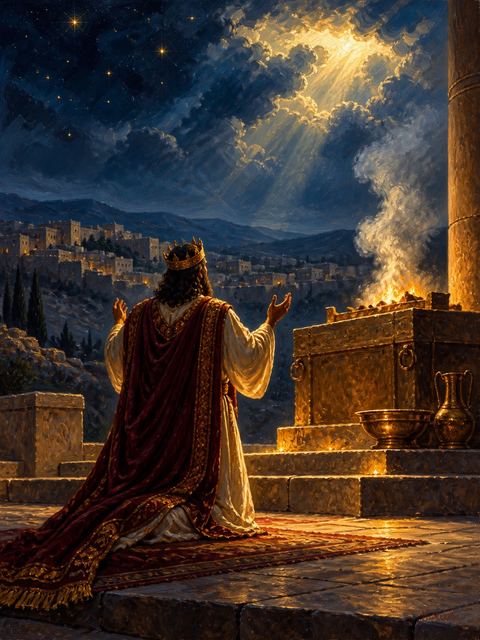
Solomon, also known as Jedidiah, was the son of King David and Bathsheba, and the third king of Israel (2 Samuel 12:24; 1 Chronicles 3:5). He was born in Jerusalem and named Solomon by his parents, but the prophet Nathan called him Jedidiah, which means "beloved of the Lord" (2 Samuel 12:25).
Solomon ascended to the throne after his father David's death, following a power struggle with his older brother Adonijah (1Kings 1-2). As king, Solomon prayed for wisdom to govern his people, and God granted him exceptional wisdom, understanding, and knowledge (1 Kings 3:1–15; 2 Chronicles 1:1–12). His wisdom was demonstrated through his fair judgments, such as the famous case of the two women claiming the same baby (1 Kings 3:16–28).
During his reign, Solomon undertook ambitious construction projects, most notably the building of the First Temple in Jerusalem, which took seven years to complete (1Kings 6; 2Chronicles 3-4). He also built a palace for himself, fortified cities, and established a strong military force (1Kings 7; 1Ki.9.15-19; 10.26-29; 2Ch.8.1-6; 9.25-28).
Solomon's reign was marked by prosperity, wealth, and international recognition. He formed alliances with neighboring kingdoms, engaged in extensive trade, and received tribute from foreign rulers (1Kings 5; 2Ch.9.26-28; 10.1-29; 2Ch.8.17-18; 9.1-28). The Queen of Sheba visited Solomon to test his wisdom and left impressed by his knowledge and the splendor of his court (1 Kings 10:1–13; 2 Chronicles 9:1–12).
However, Solomon's later years were marked by a decline in his faithfulness to God. He married many foreign women and allowed their religious practices to influence him, leading to the worship of false gods (1 Kings 11:1–8). As a result, God declared that the kingdom would be divided after Solomon's death (1 Kings 11:9–13).
Solomon is traditionally credited with authoring several biblical books, including Proverbs, Ecclesiastes, and the Song of Solomon (Proverbs 1:1; Ecclesiastes 1:1; Song of Solomon 1:1). His wisdom and proverbs were widely celebrated and studied (1 Kings 4:29–34; Pro.1.1; 10.1; 25.1).
After a reign of forty years, Solomon died and was succeeded by his son Rehoboam (1 Kings 11:41–43; 2 Chronicles 9:29–31). As prophesied, the kingdom was divided into the northern kingdom of Israel and the southern kingdom of Judah shortly after his death (1Kings 12; 2Chronicles 10).
Family
Every mention
2 Samuel3 mentions
1 Kings139 mentions
2 Kings4 mentions
1 Chronicles24 mentions
2 Chronicles74 mentions
Ezra2 mentions
Nehemiah5 mentions
Psalms2 mentions
Jeremiah1 mention
John1 mention
Acts1 mention
What the dictionary says
Peaceful, (Heb. Shelomoh), David’s second son by Bathsheba, i.e., the first after their legal marriage (2 Sam. 12).
Sources
- STEPBible TIPNR · Translators Individualised Proper Names with all References · CC BY 4.0 · github.com/STEPBible/STEPBible-Data
- Hitchcock's Bible Names Dictionary (1869) · Public domain