The BibleGospel Companion

Pilate

Πιλᾶτος · Pilatos · G4091Πόντιος · Pontios · G4194“armed with a dart” Hitchcock's 186953 mentions in 6 books, most in John (19)
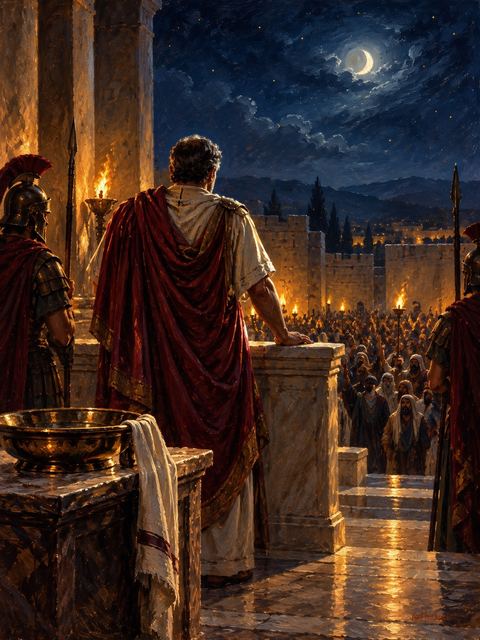
Illustration — not a likeness; generated for Gospel Companion in the app's painting style — Pilate
Illustration — not a likeness; generated for Gospel Companion in the app's painting style

Who he was

Pontius Pilate was the Roman governor (prefect) of Judea during the time of Jesus' ministry and crucifixion (Luke 3:1). He is most known for his role in the trial and execution of Jesus, as recorded in all four Gospels (Matthew 27; Mark 15; Luke 23; John 18-19).

When Jesus was brought before Pilate by the Jewish leaders, who accused him of claiming to be the king of the Jews, Pilate questioned Jesus and found no fault in him (John 18:29–38). However, faced with the insistence of the Jewish leaders and the growing crowd, Pilate ultimately gave in to their demands and ordered Jesus to be crucified (Matthew 27:24; Mark 15:15; Luke 23:24; John 19:16).

Pilate is portrayed as a reluctant participant in Jesus' death, attempting to release him but ultimately succumbing to political pressure (John 19:12). He is also depicted as a somewhat cynical and world-weary figure, as seen in his famous question to Jesus, "What is truth?" (John 18:38).

Pilate's involvement in Jesus' crucifixion is also mentioned in the Book of Acts, where the early Christian leaders affirm that Jesus was crucified under Pontius Pilate (Act.3.13; 4.27; 13.28). In 1 Timothy 6:13, Paul refers to Jesus' good confession before Pontius Pilate.

Article: STEPBible, Tyndale House Cambridge · CC BY 4.0

Every mention

53 references, counted from STEPBible, Tyndale House Cambridge · CC BY 4.0 · verse text: World English Bible (public domain)
MatthewChapter 27: 8 mentions8 mentions
MarkChapter 15: 10 mentions10 mentions
LukeChapter 3: 1 mentionChapter 13: 1 mentionChapter 23: 10 mentions12 mentions
JohnChapter 18: 6 mentionsChapter 19: 13 mentions19 mentions
John 18:29Pilate therefore went out to them and said, “What accusation do you bring against this man?”John 18:31Pilate therefore said to them, “Take him yourselves, and judge him according to your law.” Therefore the Jews said to him, “It is illegal for us to put anyone to death,”John 18:33Pilate therefore entered again into the Praetorium, called Jesus, and said to him, “Are you the King of the Jews?”John 18:35Pilate answered, “I’m not a Jew, am I? Your own nation and the chief priests delivered you to me. What have you done?”John 18:37Pilate therefore said to him, “Are you a king then?” Jesus answered, “You say that I am a king. For this reason I have been born, and for this reason I have come into the world, that I…John 18:38Pilate said to him, “What is truth?” When he had said this, he went out again to the Jews, and said to them, “I find no basis for a charge against him.John 19:1So Pilate then took Jesus and flogged him.John 19:4Then Pilate went out again, and said to them, “Behold, I bring him out to you, that you may know that I find no basis for a charge against him.”John 19:6When therefore the chief priests and the officers saw him, they shouted, saying, “Crucify! Crucify!” Pilate said to them, “Take him yourselves and crucify him, for I find no basis for a…John 19:8When therefore Pilate heard this saying, he was more afraid.John 19:10Pilate therefore said to him, “Aren’t you speaking to me? Don’t you know that I have power to release you and have power to crucify you?”John 19:12At this, Pilate was seeking to release him, but the Jews cried out, saying, “If you release this man, you aren’t Caesar’s friend! Everyone who makes himself a king speaks against Caesar!”John 19:13When Pilate therefore heard these words, he brought Jesus out and sat down on the judgment seat at a place called “The Pavement”, but in Hebrew, “Gabbatha.”John 19:15They cried out, “Away with him! Away with him! Crucify him!” Pilate said to them, “Shall I crucify your King?” The chief priests answered, “We have no king but Caesar!”John 19:19Pilate wrote a title also, and put it on the cross. There was written, “JESUS OF NAZARETH, THE KING OF THE JEWS.”John 19:21The chief priests of the Jews therefore said to Pilate, “Don’t write, ‘The King of the Jews,’ but, ‘he said, “I am King of the Jews.”’”John 19:22Pilate answered, “What I have written, I have written.”John 19:31Therefore the Jews, because it was the Preparation Day, so that the bodies wouldn’t remain on the cross on the Sabbath (for that Sabbath was a special one), asked of Pilate that their legs…John 19:38After these things, Joseph of Arimathaea, being a disciple of Jesus, but secretly for fear of the Jews, asked of Pilate that he might take away Jesus’ body. Pilate gave him permission. He…
ActsChapter 3: 1 mentionChapter 4: 1 mentionChapter 13: 1 mention3 mentions
1 TimothyChapter 6: 1 mention1 mention

What the dictionary says

(armed with a spear), Pontius.

Smith's Bible Dictionary (1863)
Read the article →

Sources